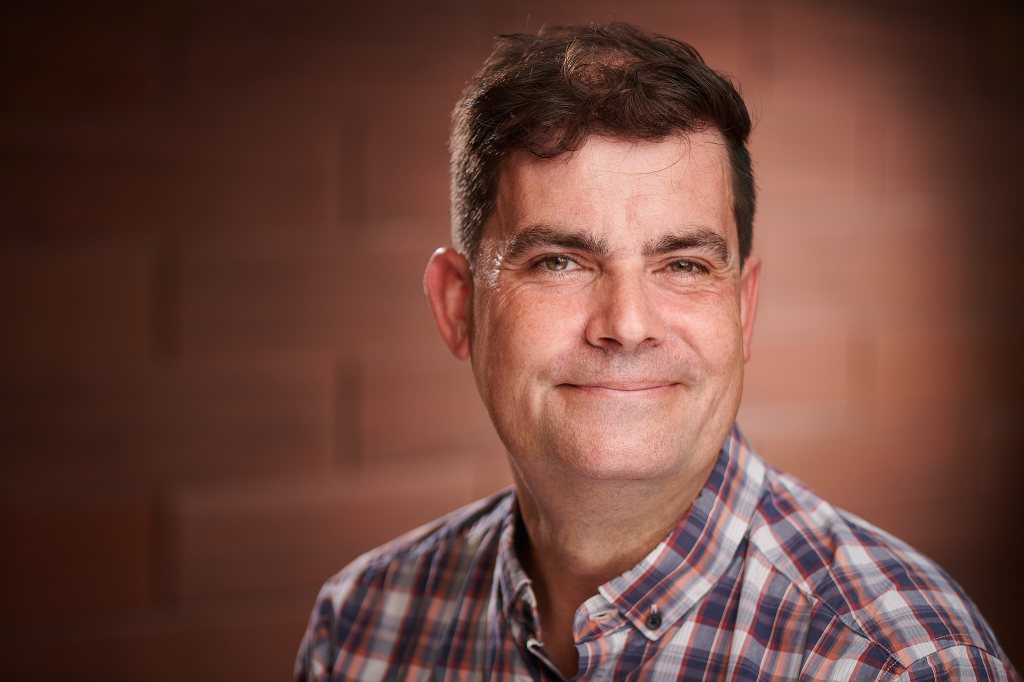
Gavin is a Senior Lecturer in Primary and Childhood education and has been subject lead for Primary Computing since 2023. Before joining Edge Hill, Gavin taught in English schools from 2006, spending time as a class teacher at all phases including EYFS, Keystage 1, Keystage 2 and Secondary SEND settings, as well as training as a specialist reading intervention teacher with UCL.
He has extensive experience of 1:1 and small-group interventions for literacy using a range of pedagogical approaches.
How did you discover Warhammer and what made you get into it?
I grew up with Fighting Fantasy in the 1980s, and from that I loved the wider world-building. I think Titan: The Fighting Fantasy World was a seminal book at that point in time. A bunch of my friends in high school and I all started playing Dungeons & Dragons.
In fact, I think we played Tunnels & Trolls first. Then somebody rocked up one day with Warhammer Fantasy Roleplay, and that was it for us. We started playing Warhammer Fantasy Roleplay around the time of The Enemy Within campaign, which is quite famous now, and it was such a rich piece of world-building. Everyone’s character was really deep.
From there, there were points in the campaign where big battles happened. The guy who was leading the game said, “Rather than just talking about it in the role-playing setting, we’ll play out the battles.” We pivoted from just playing role-playing games to playing Warhammer Fantasy Battle alongside them.
We carried on doing that through high school, and then we played all the different games, including Blood Bowl, Battlefleet Gothic, Space Hulk and the early versions of Warhammer 40K as well. For a good chunk of time, probably up until university, I was completely immersed in all these different things that Games Workshop was putting out.
Tell me more about your academic work now in mental health, and any aspects of Warhammer that you look at through that lens.
As a faculty of education, one of our focuses is mental health and wellbeing, so a number of colleagues across the faculty work on those aspects.
My academic work at the intersection of education and Warhammer is more about how we organise socially. I spoke at the Warhammer 2026 conference about the informal youth space i.e. the regular meetups and game sessions that form for young people who might not have access to things like a youth club these days.
I’m also interested in how people within the Warhammer community, whether they’re store staff or veteran players, support young people getting into the hobby. What does the wider community offer, and where is it going to take people who are attracted to playing this game?
What does it offer them in terms of things like belonging? That’s a word we use a lot, both from an education and a mental health perspective here. I’m interested in what that means for the people involved in the hobby.
I find community and belonging are a big part of the appeal of these gaming communities, and I’d like to unpack that a bit more based on what you’re seeing.
What does belonging mean to you, both from your lived experience and from your academic work and the studies you’re doing around Warhammer?
I should say that I had a gap where I just wasn’t playing regularly. I carried on painting, and painting is a big part of the whole hobby world for me. I’ve now got a son who is in his high school years, and he independently decided that he wanted to get involved with Warhammer. Returning to it through him was really nice for me.
As soon as you go into a store, you have this sense that you’re part of a bigger world. I get some quality time with my son, which is a nice point of connection, but there’s also that feeling of knowing the lore of this universe and being able to talk to people I’ve never met before. I feel
That’s developed over the recent past to the point where I’m sharing things at the conference and starting to research the social world of Warhammer players. I should point out that I have a diagnosis of combined-type ADHD.
I feel the hobby really supports me in that as well. Painting is important to me in terms of my personal time and my ability to focus. Because there’s also an opportunity to share what you’ve done during your own focused time in a friendly public sphere, there’s something that bridges the personal and the social through the hobby. I think that’s unique.
It’s very different from simply engaging with video games for my own distraction or whatever it might be. With Warhammer, there’s this connection between the time you spend doing something on your own and the opportunity to share that experience with other people.
You mentioned your ADHD diagnosis and how much you focus on the painting aspect.
What does that feel like for you when you’re painting a model? Do you feel as though you have 100% focus and don’t drift away from what you’re doing?
Broadly speaking, it’s something I can just immerse myself in. One of the things that potentially puts a strain on me day to day is the feeling that I’ve got to be productive. I feel as though everything I do has to have a meaningful outcome and that I shouldn’t be wasting time.
Generally speaking, that means I have a strong sense of time passing, along with the feeling that I must move on, complete this task and get to the next thing. Whereas, if you talk to all sorts of people in the hobby, they’ll talk about painting time. You think, “I’ll do 20 minutes,” or, “I’ll do a couple of quick layers on this model,” and then you find that four hours have passed.
I think, for a lot of people, it provides that kind of experience. I don’t know whether you’d call it a flow state, but it’s immersive, and time takes on a different quality.
For me, it’s one of the very few spaces where I can allow myself to be completely absorbed in something that doesn’t really matter in terms of producing an outcome. It doesn’t have to have an output. I’m not trying to impress anybody else, and I’m certainly not trying to win Golden Demon or anything like that. It’s just a pleasant thing to do. It’s immediate and immersive.
The word I’m looking for is autotelic. That’s the idea from game theory of something that’s done for its own sake.
I’m also interested in male mental health, and I’d say Warhammer is a great community for a lot of men who get involved for various reasons.
As you said, you’ve bonded with your son through it, and I think it’s a great way for men to talk about whatever they’re going through, whether that’s through tournaments, painting or other aspects of the hobby.
What do you think about that? Do you agree that these communal spaces can give men opportunities to be more honest with each other, or would you approach the subject from a different angle?
I agree with that to an extent. I’ll be honest. There are times when I feel nervous about masculine-dominated spaces. Although I’ve had a positive experience accompanying my son, I know there have been times when my wife has taken him to a play event in a store and hasn’t necessarily had as comfortable an experience or felt as welcome.
I think there’s an assumption that, if I accompany him and people know I’m into the hobby, I’m one of them. A middle-aged woman going into that space is something different, so I have some questions around that.
In terms of Warhammer as a space for male inclusion and male mental health, I think the angle I’d take is that we’re self-selected. It’s not simply that we’re all men; it’s that we’re a certain type of person who is attracted to the hobby and sticks with it.
We talk about painting, making things and modifying models. A lot of conversations start around either playing the game or engaging in creative activities. The Warhammer aesthetic appeals to us, but in principle, it’s not really any different from building a doll’s house. I know people talk about “war dollies” and all that kind of thing, but it doesn’t really matter what we’re doing. It could be model railways or something similar. The creative aspect, and the process of making something over time, is valuable to me and, I think, to a lot of other people in the community.
There are few spaces where you’ll meet a group of men sitting down and talking about the things they make or paint, or sharing skills around something that is inherently small-scale and aesthetic. That’s an unusual set of circumstances. You might get people talking about cooking or something similar on a forum, but I think it’s unusual in that sense. These are people talking about their creativity.
I don’t know whether this is true or simply my perception, but there’s a sense that this is a silly thing to do in wider society. It’s seen as trivial, and you know that other people might be sniffy about it or judge you in a particular way. Perhaps that means that, when you’re in that environment, you feel you’re with other people who have had a similar experience. I don’t know whether that’s part of what creates the safe space.
When I play in a store, it tends to be with a mix of people, including lots of younger players, but also people who have experienced their own mental health challenges. Some are veterans or might have experienced some kind of historic trauma. The focus on the game just diffuses what people might be experiencing day to day, so I think that’s quite useful.
A group to be aware of on Facebook and Discord is Dadhammer, which is specifically focused on male peer support within the Warhammer community. A lot of the things discussed there are serious topics. You have everything from suicidal ideation to people dealing with the loss of children and familial bereavement. Big issues that can have significant impacts on people’s mental health.
There’s obviously a stereotype of Warhammer being very male-led, and, as you mentioned with your wife, women can sometimes feel that there’s a barrier. It might not always be the case, but it can be an issue.
From your perspective, do you think communities could do more to become more inclusive for women of all ages? More generally, what are your thoughts on that idea?
I think it could be more inclusive. I don’t think it’s deliberately exclusive. Possibly, some of the exclusive elements emerge from getting a group of people with a particular disposition and a particular gender together.
I know there’s academic research that talks about this. I think the researchers draw on Warhammer as an example of a male-dominated group and a women’s knitting group as another example. Both of those feel like stereotypes, but the point is that sometimes things emerge from the group of people who have gathered together, rather than necessarily from the activity they’re involved in. There isn’t necessarily anything inherent in the activity that excludes people.
I know loads of women who play Warhammer, paint, collect and are really creative in the hobby. They do all sorts of things within the community, but they make up a much smaller proportion of the people involved. So there is that male-dominated space, which I think inherently has its barriers.
There are also a bunch of subcultures within the Warhammer community. Sometimes those are exceptionally inclusive, warm and welcoming, and you find a really dynamic mix of people. Other elements of the community might be more excluding.
It’s difficult to generalise. Even with something as niche as Warhammer, I don’t think you can overgeneralise about the community as a whole. Different groups can have very different experiences, even when they’re all part of the same hobby.
I think Warhammer is becoming more accepted in general society. I don’t believe that it’s necessarily still as niche as people might think, and I think a lot of that has to do with people like Henry Cavill.
These are the faces and actors who are leading the charge and being very mainstream about their interest in it. Cavill is building his own cinematic universe at the moment, and I think role models like that are pretty good for the fandom.
What do you think about that? Do you think Warhammer is moving towards becoming more accepted, and is it good to have these big celebrity faces leading that charge?
I think there are probably a couple of things happening at the same time. There’s definitely the Cavill effect, which I think a lot of people talk about. From the point of view of being a married, middle-aged man, my wife is much more likely to say, “Oh yeah, I’ll buy these things for my husband to do as his hobby,” because it’s something that’s in the mainstream and is more acceptable.
The popularity of the video games, particularly things like Space Marine 2, has also done quite a lot to bring Warhammer further into the mainstream. My only question about some of that is that the video games very much emphasise one part of the universe and one part of the hobby, which aren’t necessarily the bits that particularly interest me.
Things like the Secret Level episode that drew on Warhammer, along with the Space Marine games, present a particular side of it. I don’t necessarily mean violent, but it’s very macho, very smashy, bashy, crashy. It’s not about painting a 30mm model, building a diorama or reading novels.
It’s one aspect of a much bigger thing. If it brings more people to the hobby, then great. It’s just that there’s an awful lot of the universe that isn’t necessarily captured by this move into the mainstream.
Looking inside the lore and the world of 40K itself, are there any factions that interest you from a psychological or mental health point of view, either based on your research or simply because of your general interest in mental health?
I’m not a big 40K player. I played Marines through my teens, and we’re just starting to play again. I’ve gone back to Marines almost from a childhood nostalgia point of view, whereas my son is much more interested in the weirdness of the different Xenos factions. There isn’t a particular faction that makes me think, “That’s a useful metaphor for me to talk about my mental health.” I just like the variety, and I love the aesthetics.
Given the choice, I’d probably want to have loads of Eldar Harlequins or Exodites: something quirky and fun to paint that makes me obsess over putting small details onto tiny little models. I’ll probably always go with the aesthetics and those kinds of things.
Part of what I love about Warhammer, though, is how broad it is and how you can use this kind of co-created, massive world to critique things we deal with in real life.
Looking at the emerging field of Warhammer studies as a discipline, do you think there’s a lot of mileage in that, given the growing interest in the subject and the different angles people can explore?
What would you like to see more of in terms of the different themes that might be explored through academic Warhammer studies?
I find events like Warhammer Conference interesting. The level of academic rigour is great. On one level, none of us are Henry Cavill, but I think it’s telling that you’ve got people who are at the top of their game in their academic fields, whether that’s economics, human resource management or something else.
They’re applying a really high level of expertise from their specific discipline, using Warhammer as a playful lens through which to ask questions. I think that’s quite different. You have the use of Warhammer as a mirror through which to look at your own discipline. I know there are some people looking at it from a more traditional game studies perspective, and there’s room for that as well.
With your role at Edge Hill University, have you ever tried using Warhammer miniatures to illustrate points in your teaching?
Do you see any practical benefits to doing that, or is your interest more theoretical at this stage?
I haven’t done that yet, but one thing we’ve talked about is the value of extracurricular activities in schools. We encourage all our students, when they go on placement, to share their interests with the pupils. We’ve got people who run an after-school dance class, volunteer with Cubs or Brownies, or do something like the cross-country team.
I’m interested in how things like Warhammer Alliance, Games Workshop’s support programme for getting Warhammer into high schools, affect young people in schools. We’ve encouraged our students to be aware of initiatives like that, and we’re starting to look at the potential to shape a piece of research around what Warhammer Alliance means for secondary-age pupils in terms of belonging and identity.
Where does it take them afterwards? Do they continue to be members of the wider Warhammer community, or does it simply give them a sense of belonging for a period during their time in high school? Those are the kinds of questions I’d like to explore.
Are there any other thoughts you’d like to share about mental health and Warhammer?
Have you had any other observations about how people are receiving it, whether at a student level or more generally from what you see in the community, perhaps including your experiences with your son?
The thing for me is trying to shift perceptions. Because the world of Warhammer is seen as this gory, grim, dark and miserable place, people assume it’s a gothic, depressing, gloomy world. That isn’t typical of the people who play the games, build the models or make miniatures.
I think it’s easy for people to miss the satire and the humour that are woven through it. I was saying to someone the other day that, when you’ve got a universe of never-ending war, war itself stops being the relevant thing. Winning and losing don’t matter because the war is going to continue no matter what.
It does become immediate, and it remains playful. That’s what I love about it, what my son loves about it, and what we share with this brilliant international community.
–Michael Deguisa, conducting this interview from an undisclosed bunker in a far-reaching sector of the Imperium where such talks of mental health aren’t considered heresy.


Leave a Reply