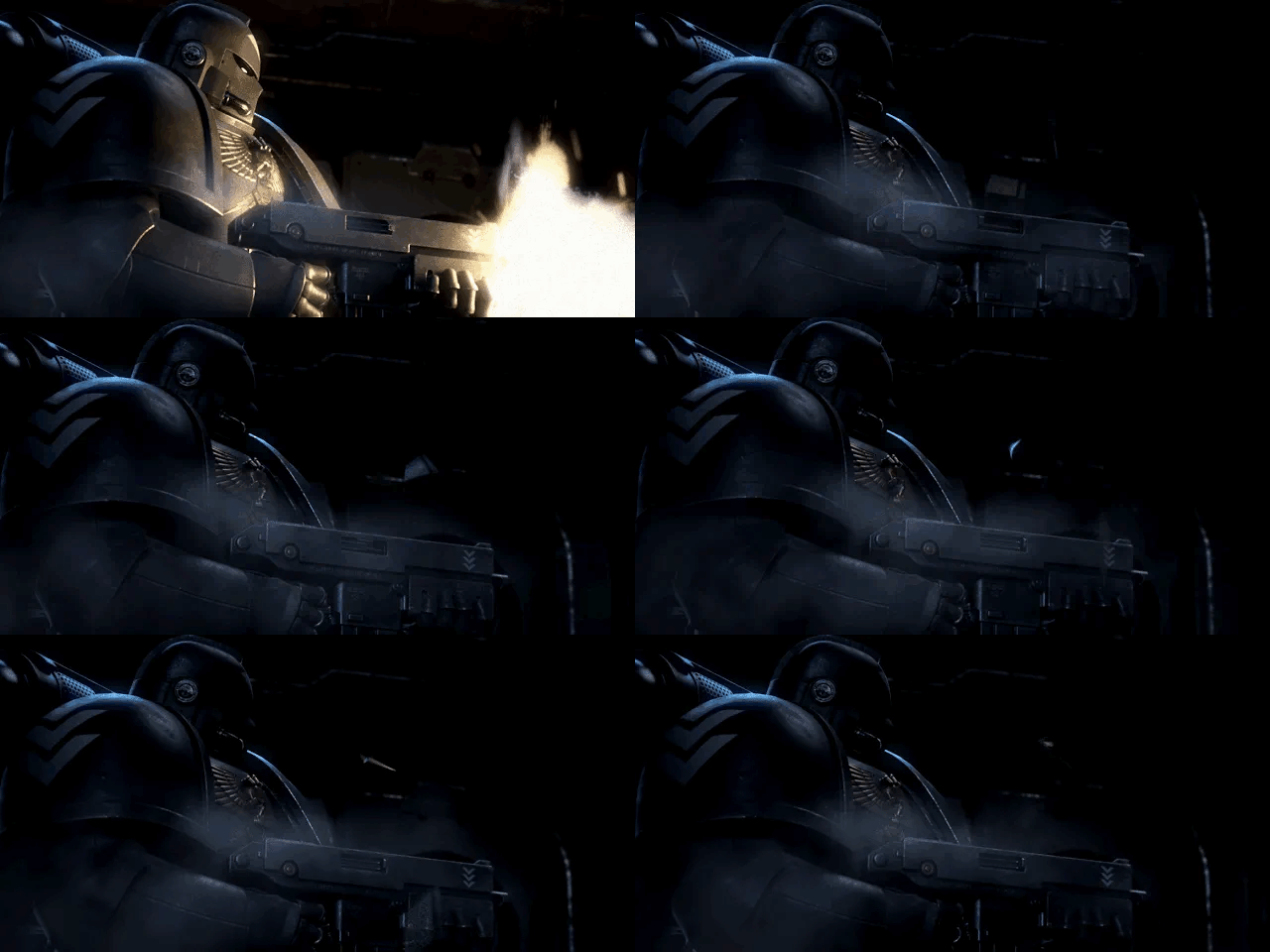
When it comes to 40k literature, few fan-coined terms are as widely understood or used divisively as bolter porn. The phrase isn’t meant to be literal of course. It’s shorthand, cynical humour in the grand tradition of the 40k fandom, used to describe a particular mode of writing where martial spectacle overwhelms everything else like character, tension, themes, hell, even basic narrative momentum.
Urban Dictionary defines bolter porn as:
“A term in regards to Warhammer fiction whenever an author spends half the page talking about how a Bolter, Space Marine, Lasgun, or some other Person or Weapon is extremely efficient at mulching absurd amounts of things to a point that it is no longer a cool description, but rather simply exists to feed the idea that something or someone is super powerful.”
Or, put even more bluntly to show the terms divisiveness by the writer who added the definition:
“It was so cool how Titus killed 100 orks by himself.”
Someone else: “I don’t know. I’m tired of people overusing bolter porn in things, It just gets so overused.”
The bloody anatomy of bolter porn
At its core, bolter porn has these characteristics:
- Hyper-detailed descriptions of weapons firing.
- Enemies reduced to stats rather than threats.
- Protagonists mowing through opposition with negligible cost.
- Combat scenes that go on for pages but don’t advance the plot.
A Reddit user has summarised the ‘standard plot’ of bolter-heavy fiction as follows:
“The space marines of X have just completed a grueling campaign that has left them exhausted and under strength yet they respond to the call from planet Y to deal with (xenos/demon), but something else (eldar,daemon,xenos,inquisition) is transpiring in the shadows that will interrupt a battle about midway through changing things completely. Will our hero(s) be able to fight this magnificently awesome battle and survive?“
I don’t think this formula is inherently bad. In fact, it mirrors the structure of many tabletop campaigns and codex narratives.
Why bolter porn exists and persists
The truth is that bolter porn exists because it works, at least on one level. Warhammer 40k is a universe built on excess with deliberately exaggerated factions. Space Marines are walking myths, post-human angels of death clad in nigh unbreakable armour. The forces of Chaos look like a vomit inducing mix of Cronenberg body horror and Del Torro dark fairytale on acid. The setting is meant to invite awe and shock, and bolter porn is one of the most immediate ways to deliver it.
There are also structural reasons like:
- Black Library’s output volume encourages familiar, repeatable beats.
- New readers need to see that Space Marines are apex, badass characters.
- Tie-in fiction must reinforce brand identity as much as tell a story.
- Action scenes in an IP known for constant fighting is easier to sell than introspection and moral ambiguity.
In moderation, bolter porn may serve as narrative shorthand. A single brutal combat can efficiently establish tone and faction identity. The problem starts when spectacle replaces stakes, and power is shown so relentlessly that nothing can meaningfully challenge it. For example, when a Space Marine is introduced by killing fifty enemies, and then later kills thousands more with ease, something has been lost. The bolter might as well be white noise.
When power fantasy undermines grimdark and bolter porn becomes comfort reading
40k’s tagline of in the grim darkness of the far future, there is only war doesn’t just signal violence. Crucially, it signals the cost of that violence and how a broken system can’t be fixed because those in charge are blinded by dogmatic hatred and those who resist are branded heretic for better or worse.
Endless bolter porn can flatten the setting’s bleakness into something strangely triumphant. If protagonists never meaningfully suffer or never lose anything that matters, the universe stops feeling oppressive and starts feeling like a shooting gallery. Ironically, excessive power fantasy can make 40k feel less dark.
On the other side of the coin, bolter porn isn’t a flaw for fans who treat the stories like comfort food. You know what you’re getting with loyal warriors, impossible odds, impossibly louder guns and a sense of order being imposed through overwhelming force.
In a chaotic real world, there can be something soothing about a universe where problems are solved by absolute conviction and superior firepower, even if that universe insists it’s terrible. Seen this way, bolter porn isn’t so much about bad writing as it being a ritual. A liturgy of violence, repeated because it feels right.
The surgical use of bolter porn: Wraight’s Legends Of The Wolves and Dembski-Bowden’s Night Lords
Some of the most respected writers in the Black Library catalogue understand that bolter porn is not something to be indulged endlessly, but deployed surgically. Chris Wraight’s Legends Of The Wolves trilogy and Aaron Dembski-Bowden’s Night Lords trilogy provide two of the clearest examples of how overwhelming violence can retain its impact precisely because it’s used strategically.
Wraight concentrates on the saga of the Jarnhamar pack, a band of grizzled Grey Hunters with centuries of combat experience that are tasked with protecting an Imperial planet seized by a plague. Wraight understands that his characters are already mythic and they don’t have to constantly prove it by mulching enemies in ever-escalating quanties. Jarnhamar chooses to do so because it’s inherently a part of the culture of the Space Wolves.
In Legends Of The Wolves, bolter fire and combat is framed as brutal and precise, done with purpose instead of spectacle. When Wraight spends time describing battle scenes at length, the language feels like it complements the fighting style of each character, whether it’s the leader of the pack Gunnlaugur swinging his power weapon or the young Blood Claw Hafloi ripping into enemies with his bolt pistol and axe. Jarnhamar and the Space Wolves by definition are executioners of necessity. Their violence is bound in honour and a warrior creed.
Dembski-Bowden’s Night Lords trilogy takes a different but equally surgical approach that could even be termed as anti-bolter porn by design. The Night Lords series focuses on the exploits of First Claw and the protagonist Talos struggling to give his company meaning and purpose. The key thing is that Talos and the remnants of the Night Lords aren’t conquerors at the height of their powers. They are scavengers, raiders and terrorists surviving on reputation, fear and timing.
With that in mind, each battle, whether extended or short, has its place because the Night Lords are focused on shock and awe. They don’t seek fair fights. They sabotage power grids, isolate populations, broadcast flayed corpses and vanish before retaliation happens. The violence they unleash frames the Night Lords as terrifying because they don’t always need to mulch infinite enemies. Sometimes, the knowledge of what they could do hangs heavier than extended fight scenes.
Dembski-Bowden also denies the reader a stable heroic viewpoint. There’s no catharsis to watching Talos kill enemies because the narrative refuses to treat those moments as victories. Each act of violence reinforces the decay of his legion: their dependence on cruelty, their internal fractures, their inability to build anything lasting. The bolter becomes just another synonym for a culture that can’t imagine or create a future beyond the next raid.
The line between spectacle and substance
To sum everything up, I believe bolter porn isn’t a problem simply for existing as a concept. It’s an issue when it crowds everything else. The best 40k fiction understands that power is at its most interesting when it’s constrained by doubt and ideology or by consequences that no amount of ceramite can deflect.
A bolter firing is cool. A bolter firing when it shouldn’t or when it damns the one pulling the trigger is the essence of 40k. In the end, bolter porn is a symptom of the setting’s greatest strength and weakness: excess. Like the Imperium itself, it works until it doesn’t, and then it keeps going anyway, louder than ever before. And maybe that too is part of the point.
– Michael Deguisa, stopping here before this metaphor needs a kill count.
 40K Pulp
Leave a reply to Space Marine LegendS: Ragnar Blackmane Review: The Bloody Cost Of Maturity & Honour – 40K Pulp Cancel reply