Warhammer 40,000 is a world rich for mental health exploration. Now, the very concept of mental health would probably be a foreign concept to your average Imperial and even more farcical for a Chaos worshipper. And that’s precisely why it’s interesting to explore various conditions from depression to self-harm because these conditions are magnified like everything else in the 40k universe without ever being named.
Brainwashing too, is a prominent theme in Warhammer, with myriad cults having their own subjective beliefs about the God-Emperor and their place in the galaxy. Kibellah of the Bloodspun Web is an intriguing example of what happens when brainwashing is done in service of religion.
A Loyal Assassin Of The Bloodspun Web
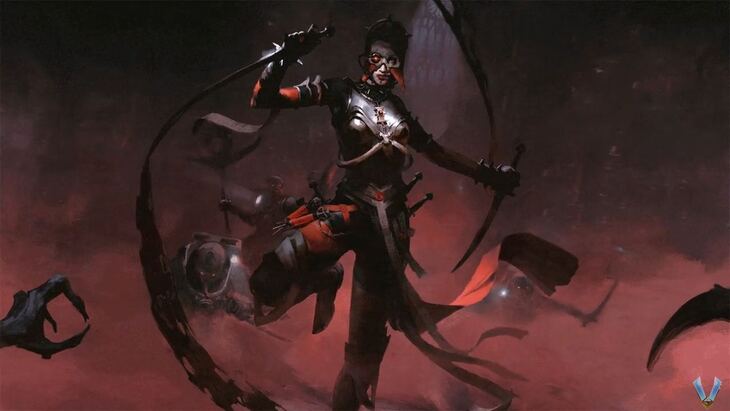
Kibellah is a DLC character in the game Rogue Trader, a member of the main character Von Valancius’ retinue and bodyguard. She’s a part of the Bloodspun Web, an Imperial death cult that lives aboard the Rogue Trader’s ship and believes themselves to be holy assassins of The Emperor. The cult was founded by a person called the Matriarch Spider who once gathered a band of killers together to stop a Chaos breach aboard the Von Valancius flagship. Each assassin is called a spinner, receiving instructions on who they must kill through receiving psychic messages through an incomplete deck of the Emperor’s Tarot.
Kibellah is the Second Spinner, the heir apparent to the Vizsier of the Bloodspun Web and the one who’s next in line to take over. When she first appears, Kibellah is fanatically devoted to the beliefs of the Bloodspun Web and her role in being the Rogue Trader’s blade and shadow.
On explaining the Bloodspun Web’s beliefs, Kibellah describes it as:
“Through blood, sweat and tears, and the strength of their convictions, the servants of the Undying One spin the souls of your subjects into threads of balance…It is the Vizsier’s duty to watch over the flock. To lead those who want to learn more about the Undying One but are fearful of death, and guide those who seek answers but do not know how to live.
The Vizsier protects all – those who do not know we exist, those who are grateful for our service, and even those who hate us. The Vizsier sees what is to come, remembers the past, and accepts the present. They spin the web of faith and blood so strong that no enemy may sunder it.”
Kibellah doesn’t see herself as human. The cult have conditioned her to believe she is an instrument and weapon, honed to be as sharp as the swords and daggers she wields in service of the Emperor and her Domin Von Valancius.
As part of her conditioning, Kibellah engages in several rituals to continually prove her loyalty to the Bloodspun Web and the belief system she’s been given. One of them is ritualistic self-harm which involves her cutting her flesh as a form of religious flagellation and reminder to dull her sensitivity to pain.
She explains this practice as:
“Tools for tempering the flesh. If a spinner neglects this practice for too long, their body will weaken and their sensitivity to pain might return. If it does, they will feel the overwhelming agony of every wound they have ever endured…and go mad with torment before the Undying Emperor whispers their name.”
Kibellah even directs the Rogue Trader to inflict harm on her with the cutting tools she carries. If the player chooses this option, she remains as stoic as ever, indicating that she has become so desensitised to being cut that she takes pride in being able to carry out this duty.
For her, all scars are “sacred marks of the Undying One’s service. Death has bestowed them upon me. Though others may cherish hollow riches or meaningless beauty, it is my duty to cherish His gift of blood. Each wound is a symbol of our service to Him. Each drop of blood carries His blessing. To renounce these scars is to renounce the Undying One Himself.”
Lost And Found In Labyrinths
Another mental health technique that Kibellah uses to assert her allegiance to Bloodspun Web and for meditation is to paint a complex labyrinth that represents a physical and spiritual path to walk.
She performs various rites in the labyrinth like the ritual of binding to formally bond herself to the Rogue Trader and the ritual of light to guide Von Valancius through her own mind as a way to deepen their bond if they are in a romantic relationship. Kibelleh describes the labyrinth as “the maze of my mind. Although it is my predestination alone to walk its corridors in search of answers, your image [The Rogue Trader] must become a part of the tangle.”
There’s been a lot of research conducted into the therapeutic practices of labyrinth walking like this. The labyrinth is meant to symbolise a predestined journey that the person who walks must trace through all the loops to get to the centre. By doing this, anxiety is meant to be lowered and there’s the opportunity for a rebalancing of life and stress.
Indeed, it seems Kibellah uses the labyrinth during times of doubt and extreme stress, qualities that become more prominent later in the game when she struggles with her desire to be faithful to the Bloodspun Web and the blooming of her humanity Von Valancius can awaken in her.
There comes a point where the Viszier directs Kibellah to kill her family. It’s revealed that Kibellah’s real name is Naaki Erebis, the child of a royal family who was given to the Bloodspun Web as a baby to be raised in their ways.
This moment is crucial to Kibellah’s character development. It’s possible for her to become more merciful and human and find a way to use her brainwashing to direct the Bloodspun Web in a more benevolent direction based on the Rogue Trader’s compassionate influence.
This path culminates in Kibellah asking Von Valancius to travel the labyrinth with her one last time to help her find her way out of it so they can forge a new beginning together. Given the freedom to choose and decide her own path, Kibellah forms a new tenet for herself called the Grace Of The Web: the realisation that she and she alone is in control of her own destiny.
Experiencing Kibellah’s mental health journey and character development is one of those few happily ever after instances that the poor souls of the Warhammer 40,000 universe can hope for. There’s still plenty of blood, gore and murder, but when an assassin can realise she’s not just a tool for a god’s will and is able to be her own person, well, that’s a kind of peace worth celebrating all the same.
– Michael Deguisa, writing this from a bunker where the lights are flickering like dying faith, observing that in a galaxy built on fanaticism and blood, the rarest act isn’t always open rebellion, but the decision to think for yourself.
Not that the Imperium would ever reward such a thing.
 40K Pulp
Leave a comment