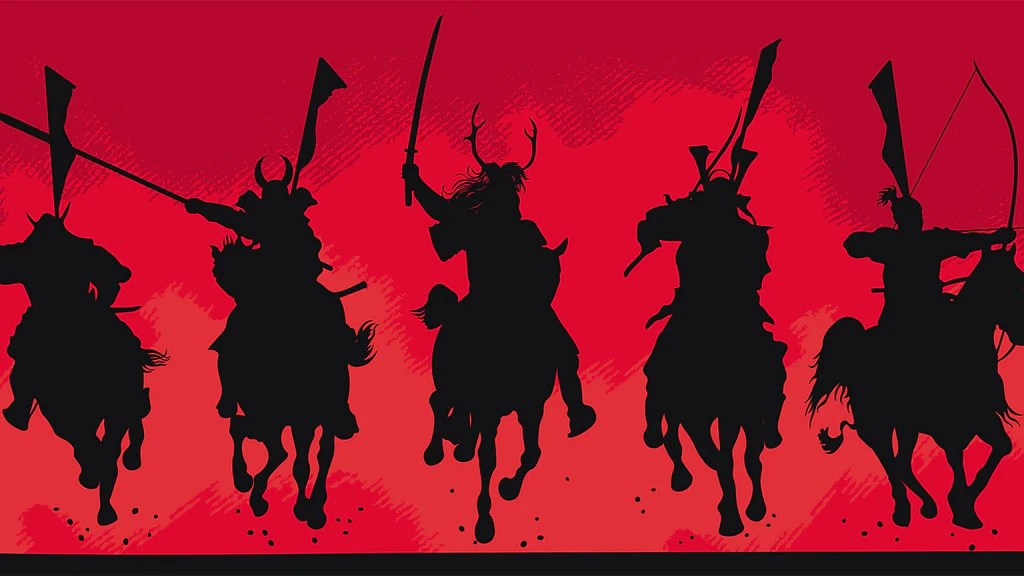
In the world of Warhammer 40k, many of the human factions draw inspiration from ancient Western cultures. For example, the Space Wolves are influenced by the Norse tribes of Old Terra, while the Ultramarines have an ancient Roman aesthetic. What’s less represented within the factions are Eastern cultures and one might expect that a classical warrior archetype like the Japanese samurai would have some kind of presence.
You would be right in your expectation on a small scale. For there’s an elusive and mysterious character in Warhammer 40k lore who for all intents and purposes was the last samurai of his culture and lineage. His name was Yasu Nagasena.
Who is Yasu Nagasena?
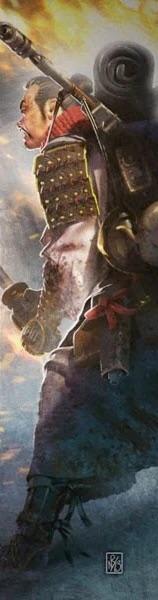
Yasu Nagasena was an expert tracker and hunter serving the League of Black Ships during the Horus Heresy era and has appeared in two Black Library books and one audio book: The Outcast Dead, The Crimson King and Wolf Hunt. A born warrior, Nagasena was said to be the last descendent of an ancient order of Terran warriors who we can assume were samurai based on his armour and weaponry.
For starters, Nagasena wore customised Carapace armour that was designed in a samurai tradition. Here are the some of the pieces of traditional samurai armour that inspired Nagasana’s armour:
- Dou: The main body of samurai armour in the style of a fitted cuirass.
- Sode: Large shoulder plates attached to the dou.
- Kote: Armoured sleeves that extended to the shoulder and came with gauntlets for protecting the hands.
Secondly, Nagasena wielded a katana that he saw as an extension of his soul, as described in Wolf Hunt:
“He slings the long-las over his shoulder and holsters the pistol before reverently lifting a scabbard of lacquered wood, jade and mother of pearl from a rack of rich cherrywood. The sword’s handle is wound in leather of the palest cream and its blade was crafted with love and an attention to detail that no machine will ever replicate. Nagasena knows the weapon as Shoujiki.”
In Japanese, shoujiki translates to honesty, straightforwardness and integrity. This hints at Nagasena’s personality and desire to adhere to the idealised practices of his ancestors.
In reality, samurai weren’t always honourable or chose to act with integrity. They would fight in whatever way would help them achieve victory. But Nagasena was adamant in embodying the romanticised traditions with how he carried himself.
He was loyal to his superiors, like the primarch Rogal Dorn and expecting that same loyalty and commitment from the people around him. In Wolf Hunt, Nagasena has this exchange with his housekeeper Amita:
“If I am to die on this hunt, I do not wish to leave loose ends in my wake. The villa is yours. This is my wish.”
Amita pushes the document away. “If I am told you are dead, I will sign it, but not before.”
Nagasena is humbled by her fierce devotion and belts Shoujiki around his waist. His hand settles naturally on the textured grip.
“Sign it,” he says softly. “Even if I kill this man, I do not think I will return.”
“Why not?”
“Because the mountains have said goodbye,” says Nagasena.
Amita nods, accepting his cryptic answer.
Here, Nagasena rewards Amita for her years of service as an old Japanese daimyo (lord) would have done to one of their retainers. His attitude is that of a man who has accepted the ephemeral nature of the universe as a samurai would, and doesn’t want to leave behind any unfinished business.
Standing Up To Space Marines
Eventually, Nagasena went toe to toe with Lucius The Eternal, a Chaos Space Marine from the Emperor’s Children Chapter. The fight is described in Crimson King:
“On your left!” cried Sanakht, thrusting his hand out with what power was left to him as a curved blade arced into the fractional gap at the beautiful swordsman’s gorget. Legion reflexes were inhumanly fast, but this was a master’s cut, travelling the shortest route to its target.
Even Lucius couldn’t avoid it.
Concussed and without enumerations, Sanakht’s kine-push was weak and unfocused, a neophyte’s effort. It altered the blade’s course by a mere three millimetres. But instead of flesh, it sliced a sparking groove across Lucius’ gorget. The swordsman’s eyes went wide and Sanakht saw frustration at an answer denied in his expression.
Lucius danced away from a swift reverse cut, his sword flashing up to block a stunning chain of life-ending strikes. He circled, parrying and blocking, now relishing the contest. The mist cleared and Sanakht saw who dared face Lucius.
A mortal of the Dragon Nations, wearing loose-fitting robes well suited for swordplay. He wore no armour – further proof he was utterly insane – and fought with a blade of near-perfect balance and curvature.
“This one has skill!” said Lucius, deflecting precision blows that would have left a lesser man in pieces.
“Kill him and be done with it.”
“Not till I teach him a lesson or three.”
As the trauma of his injury began to fade, Sanakht pushed his mind into the higher enumerations. He stabbed a psychic barb into the mortal’s mind. The man staggered, only just managing to turn aside a thundering blow that ought to have cut him in two.
“Don’t you dare!” cried Lucius, shooting Sanakht a venomous glare. “Don’t you dare touch him. He’s mine.”
Sanakht withdrew the barb. He had already seen enough.
Yasu Nagasena. An agent of the Emperor. Sent here by the Sigillite on the word of..
Sanakht swung onto one knee. Both swords leapt to his hands.
Lucius switched his grip with a beatific smile, matching the mortal’s angular two-handed posture. They traded blows for a handful of seconds – an eternity longer than most would have lasted against Lucius. But no matter their skill or heart, a duel between a mortal and a legionary could end in only one way.
Lucius parried a perfectly executed thrust and rolled his wrists to trap Nagasena’s blade in the crook of his elbow. He twisted his arm and the gleaming blade snapped cleanly in two.
The look of pain on the mortal’s face suggested he’d lost a firstborn son. Lucius laughed at Nagasena’s horror and stepped in close to haul him from his feet. He held him close as if studying an idiot savant. “You’re good,” he said, “but you’re no little raven.”
Nagasena struggled in the swordsman’s grip, but Lucius was already bored of him. Rather than honour his foe with a clean death, Lucius simply hurled him from the balcony.
While Nagasena couldn’t match the strength of a Space Marine, he was able to hold his own as a baseline human through sheer skill and force of will alone. This is a truly badass moment that showcases a rare instance of a human being able to stand against a Space Marine.
It goes to show that heroes are usually measured in impossible terms in Warhammer 40,000. Space Marines shatter armies and entire worlds burn in the name of the Imperium. Against that backdrop, a lone human swordsman should barely register. And yet Yasu Nagasena did.
Part of what makes Nagasena so compelling is his humanity. He possessed discipline and the belief that how a warrior conducts himself matters even in a universe where honour is rarely rewarded. In a setting defined by overwhelming power, Nagasena represented the stubborn persistence of personal code.
Perhaps that is why his story resonates so strongly. Amidst the thunder of bolters and the march of transhuman armies, the last samurai of Old Terra reminds us that sometimes the most powerful act in the 41st millennium is simply refusing to yield and endure no matter what.
– Michael Deguisa, writing from a quiet and ancient stone garden in the Pan-Pacific district of Holy Terra, where a patient caretaker is methodically raking perfect lines through the gravel while a visiting off-worlder stomps straight across them asking where the “good battles” happened.
The funny thing about warrior traditions is that some are forged in thunder and bolter fire, and some are measured in the discipline it takes not to disturb the pattern.
 40K Pulp
Leave a comment