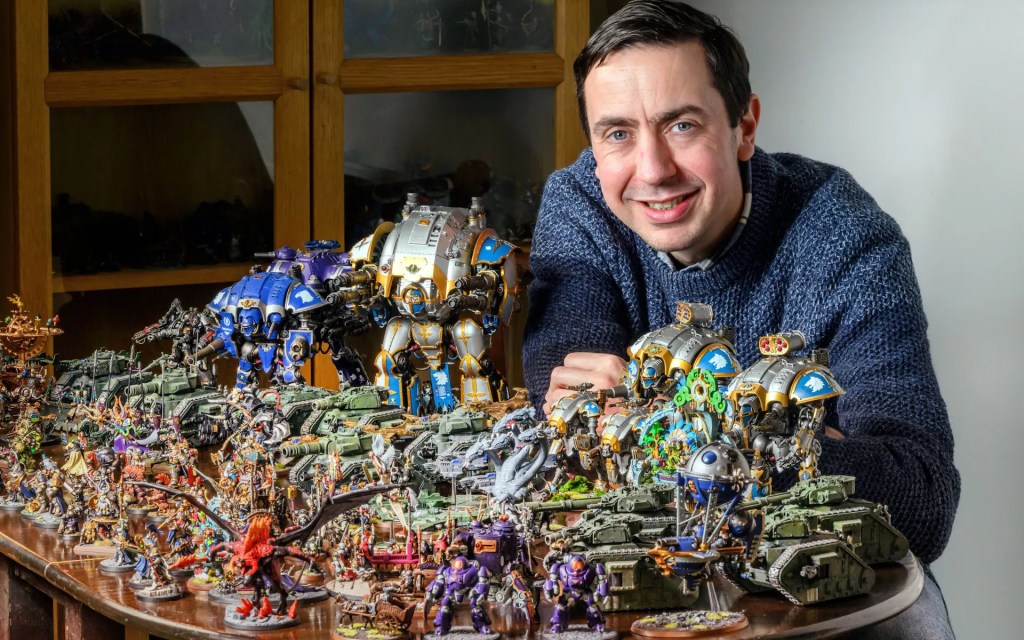
Photo credit: Paul Cooper.
There are few fictional universes as expansive, enduring and unexpectedly thoughtful as Warhammer 40,000. For some, it begins with a brightly lit shop and a starter box featuring Space Marines. For others, it begins with a novel picked up out of curiosity or by accident. For many, it becomes something harder to explain – a structure of friendship, a creative discipline, a soothing ritual of assembling and painting plastic into meaning, an outlet for gaming.
This interview series, Why We Warhammer, begins from a simple idea: the hobby is never just about the hobby.
Warhammer has long occupied an unusual cultural space. It’s vast, commercially successful, philosophically dense and emotionally complex. Its worlds are brutal, its theology unstable, its politics intentionally uncomfortable. People return to it year after year, decade after decade.
Which raises the question of why? Why does this universe famously described as a place where “there is only war” generate so much loyalty, discussion, reflection and comfort? Why does it persist not only as entertainment, but as a framework through which people explore power, death, identity, belief, and the machinery of the human condition?
To begin answering that question, I start with Dr Mike Ryder, a founder of the Warhammer Conference who has a desire to build Warhammer studies as a legitimate field of academic study and conversation.
I first came across your work through the Telegraph article that mentioned how much you’d spent on your Warhammer collection over the years.
I’d love to hear how you got into the hobby and how it eventually led you into what you’re doing now in academia. Why is your Warhammer enthusiasm still so strong today?
I’ll footnote that Telegraph article straight away. The headline was a bit misleading. The original interview wasn’t meant to be about how much money I’d spent. That series likes to focus on finances, and right at the end they asked, “How much have you spent?” I said I didn’t really know and did a rough back-of-an-envelope calculation. They ran with that number. So when you read the article, it’s much more about the hobby itself than the money. I always feel slightly awkward about that headline.
To rewind to the beginning: I discovered Warhammer in the mid-nineties. I was already into model making and was a voracious reader of science fiction and fantasy. One day I was out with my parents in Canterbury, wandering down a side street, and we came across this bright, exciting shop with incredible stuff in the window. I was completely drawn in. I took home a little leaflet and saved up my pocket money to buy the Warhammer 40,000 starter set—third edition, the one with the Black Templars on the front. That iconic cover is probably one of the most famous they’ve ever done.
From there I started reading White Dwarf, and then the novels. The Gaunt’s Ghosts books really stood out early on and became comfort reading for me. Even now, twenty-five years later, I still consider them among my favourite books. There’s something very real and human about them, despite the distant planets and alien enemies. Other members of my family got into them as well.
Like most people, I started collecting Space Marines. They’re in the box, they look cool, and you can paint them however you like. As you get deeper into the lore, you discover more factions and perspectives. When you’re young, it’s also about how much money you have. I remember deciding to start an Imperial Guard army when the Catachans were big. I struggled with painting them more than Space Marines, but over the years I’ve had different armies come and go. The books, though, have always been constant. I’ve got several shelves of them.
My academic career eventually took me into science fiction studies. I started seeing this interesting crossover between my academic interests—science fiction and philosophy—and my hobby interests—Warhammer 40,000. What struck me was that, in academia, people talk about Star Trek, Star Wars, or Dungeons & Dragons, but there was almost an intellectual snobbery around Warhammer. That fascinated me. Warhammer is massive. The universe is huge. There’s an enormous amount of content, and for the most part it’s cohesive and structured.
It’s also deeply philosophical. It’s grimdark and brutal, but it cuts to the core of what it means to be human with our relationship with death, power, identity and belief. So I started putting feelers out. I wanted to pitch a “Warhammer and Philosophy” book to the Wiley Blackwell “and Philosophy” series. They turned it down, saying Warhammer wasn’t big enough. I found that extraordinary when they’d published things like Bridgerton and Philosophy and Rick and Morty and Philosophy. I applied again a couple of years later after the Henry Cavill Amazon news and I got the same answer.
So I reached out to Thomas Arnold in Heidelberg, who had written a blog on Warhammer and philosophy. We discussed collaborating and decided to test whether there was academic demand. That led to the Warhammer Conference. Two or three years later, we’re about to host our third conference. We’ve secured some funding and are expanding into themes like mental health. There’s clearly real interest, and we’re keen to see how far we can build this.
For people unfamiliar with the Warhammer Conference, what’s the format? What are the criteria to apply? Is it in person, online, or hybrid?
The conference runs in a hybrid format, with both in-person and online streams. This year the in-person event is at the Frankfurt Institute for Advanced Studies on the weekend of 26th–27th September. Attendance is free, whether in person or online. People register through our website, www.warhammer-conference.com. We record all talks and upload them to our YouTube channel so they’re accessible afterward.
To apply, you submit a 300-word abstract. We review submissions for academic merit and quality. We welcome professional academics and interested amateurs alike. Some of our best talks have come from people with undergraduate or postgraduate backgrounds who brought fresh perspectives.
Presentations are 15–20 minutes via slide deck. We’re not currently taking full written papers for publication, though that’s something we’d like to explore in the future.
This year we’re expanding our mental health strand. In previous conferences we had talks from a pastor in the US military using Warhammer to support veterans with PTSD, and from someone who used the hobby during incarceration as part of their rehabilitation journey. We’ve also had research on the “flow state” of hobbying. We’ve secured a small pot of funding from the AHRC’s Impact Accelerator Account to support further work in this area.
Warhammer seems to be moving from niche geek culture into mainstream pop culture. What do you think has driven that shift?
I think society has become far more open to what was once called “geek culture.” In the eighties and nineties, Warhammer was associated with a very specific demographic that was often male, nerdy, introverted. Over time, perceptions have shifted.
The rise of comic book movies helped enormously. Marvel and DC films have made geek culture mainstream. Television and film increasingly celebrate that identity. People are more open about hobbies generally.
The internet has played a role too. Games Workshop had a complicated relationship with online communities in the past, but in recent years they’ve embraced social media and digital engagement very effectively. Merchandising, tie-ins, and especially video games have broadened the audience. Titles like Space Marine 2, Dawn of War, Darktide, and Vermintide have brought new people in. Not all adaptations have been hits, but the strong ones have significantly raised the profile of the IP.
There have also been conversations about inclusivity and toxicity in parts of the community. What more can be done to foster inclusivity?
This goes beyond Games Workshop alone. Like many brands, they’ve had their IP appropriated by vocal minorities online who interpret it in ways the company never intended.
I have sympathy for their position. They’ve taken strong steps of clear codes of conduct at official tournaments, banning fascist symbols at events, and making public statements like “The Imperium is driven by hate. Warhammer is not.” They’ve explicitly said if you hold extremist views, they don’t want you in the hobby. That’s a bold stance.
We’re also seeing greater diversity in storytelling and authorship. Writers like Victoria Hayward and Jude Reid are contributing new perspectives. Representation in models and narratives is increasing.
There will always be a minority resistant to change. Warhammer can attract introverted, highly invested individuals for whom the hobby becomes part of their identity. When something feels personal, changes can feel threatening. But overall, I think Games Workshop has handled it as well as it reasonably can given the complexity of the internet and society.
Beyond painting as a mindful and mental health activity, what has Warhammer offered you personally?
The novels have been huge for me. But there are multiple layers. Hobbying is deeply mindful as in cutting, assembling, painting and converting models into something unique. It’s creative and grounding. There’s also a community dimension. Once you find the right group, Warhammer becomes a vehicle for friendship and connection.
It’s particularly powerful for male friendships. There’s a wider societal issue around men forming deep connections and discussing emotions. Warhammer provides a medium for that interaction.
Even list building and army design can be mindful. When I was younger with very little money, I’d spend hours designing perfect future army lists and thinking through loadouts, points, and how everything would evolve. It sparks imagination and narrative thinking. You’re always building stories in your head.
Philosophically, are there particular schools of thought that stand out in the 40K universe?
Absolutely. The Warp alone makes it philosophically rich because it blurs metaphysics, emotion, and ontology. My colleague Thomas Arnold has explored the metaphysics of Warhammer: multiple realities, factional perspectives, competing truths.
Even Space Marines aren’t a single philosophical entity. You might read them as stoic figures; someone else sees the Space Wolves as Viking-like warriors who balance brutality with ritual and feasting.
Personally, I’m drawn to biopolitical and existential questions, especially the boundary between life and machine. Servitors and Dreadnoughts fascinate me. At what point does humanity end and machinery begin? That grey zone between life, death, and living death is philosophically rich.
Others bring psychoanalytic, political, or theological perspectives. Warhammer is flexible enough to accommodate almost any framework.
Are there particular factions or characters that resonate most with you?
Narratively, I love Dan Abnett’s work like Gaunt’s Ghosts, Eisenhorn, Double Eagle, Interceptor City. The humanity in those stories is compelling. Even the Horus Heresy novels often filter events through human remembrancers because we can’t fully inhabit a Space Marine perspective.
I have an Ork army. I both love and hate them. They’re anarchic and inventive, but tonally they sit slightly apart from the grimdark aesthetic I’m drawn to.
Increasingly, I’m interested in the Adeptus Mechanicus, specifically the fusion of human and machine, and their internal theological disputes about the Emperor and the Omnissiah. That intersection of faith, technology, and identity fascinates me. There’s so much depth across factions like the Necrons, Chaos, Imperial Guard to name a few that you have to limit yourself. It’s impossible to take it all in.
What’s next for you in the world of Warhammer?
My main academic role is in digital marketing, social media, and advertising, alongside science fiction and philosophy. Warhammer began as a way to integrate my personal interests into academic work.
I’d like to continue building Warhammer studies as a legitimate field with more conferences, publications and dialogue. Myself and colleagues at the Warhammer Conference are exploring potential publications now, though it’s early days.
We’d also like to take the conference international, perhaps smaller offshoot events in the US, Australia, or New Zealand. Funding is the main challenge. The conference is currently free because we host it through institutional partnerships. Securing sustainable funding would allow us to expand.
We didn’t expect this level of growth. The first year, we hoped for a dozen people; we ended up with around 50 speakers. In year two, we had nearly 100 applications and had to turn away over a third due to capacity. We’ve also had media coverage from the Financial Times, The Telegraph, The Guardian, and PC Gamer.
As long as people are interested, we’ll keep building it. It’s time-consuming and unpaid, but it’s genuinely exciting to see the momentum.
– Michael Deguisa, writing under the watchful gaze of several unpainted Space Marines. A reminder that even in the grimdark, deadlines remain undefeated.
 40K Pulp
Leave a comment